
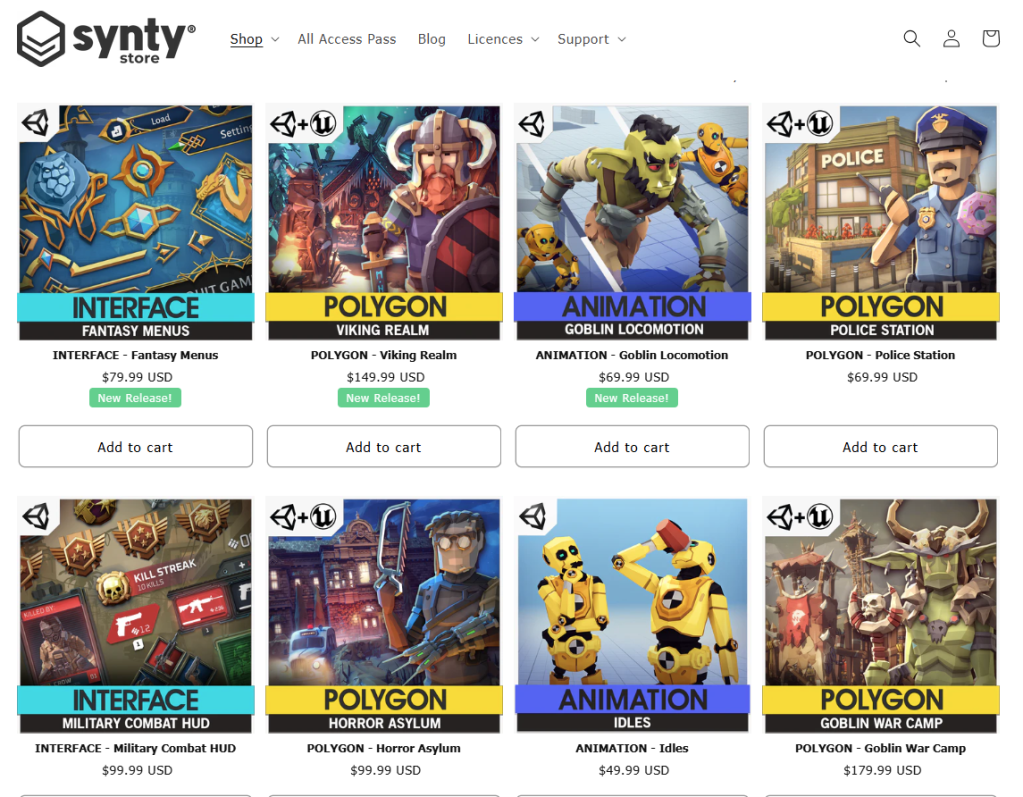
When starting Legend Games, I had one mission: bring compelling, story-driven experiences to life without getting crushed by the overhead that comes with building a game from scratch. As a solo indie developer with a big vision, I quickly realized that every decision matters—especially when it comes to time, budget, and style.
That’s where Synty Studios entered the picture—and honestly, I haven’t looked back since.
This article is not sponsored in any way. I just genuinely love what the Synty team has created, and I want to talk about how using their assets has not only made development smoother, but also elevated the creative potential of our games here at Legend Games.
The Joys of Synty: A Powerful Tool for Indies
If you’ve ever browsed the Unity Asset Store, chances are you’ve seen Synty’s work. Their modular, low-poly art packs are vibrant, cohesive, and cover a huge range of genres—from fantasy villages to sci-fi space stations to gritty war zones.
Why Synty? Here’s the breakdown:
🎨 Style That Pops Without Overcomplicating
Synty’s low-poly aesthetic isn’t just beautiful—it’s practical. It strips away unnecessary complexity, focusing on silhouette, color, and clarity. This makes it incredibly easy to read environments and characters at a glance, which is essential in games where visual communication is everything.
For Legend Games, that clean style became a design choice—not a compromise. It evokes nostalgia while still feeling fresh, and it leaves room for storytelling and worldbuilding to shine.
💸 Price That Actually Makes Sense
Let’s be real: building a game is expensive. Art is one of the biggest time and money sinks in game dev, especially for small studios or solo devs.
Synty assets offer massive value. For the price of hiring a freelance artist for a few weeks, I’ve been able to get hundreds of high-quality models, props, environments, and characters—ready to drop into Unity.
They often bundle assets and run sales, so you can grab enormous collections that can serve as the foundation for multiple projects. As a developer watching every dollar, this was game-changing.
⏱️ Development Time: Cut in Half, Not Quality
There’s no getting around it: game dev takes time. But with Synty, I’ve been able to go from gray-box prototypes to fully realized levels in a fraction of the time.
No more getting stuck on modeling trees or UV unwrapping crates—I can focus on what really matters: designing fun puzzles, building emotional story moments, and crafting immersive gameplay.
But Isn’t That Just an “Asset Flip”?
Ah, the dreaded term: asset flip. It gets thrown around a lot, and not always fairly.
Let me be clear: using pre-made assets does not mean you’re making a lazy, soulless game.
What matters isn’t where the pieces come from—it’s what you do with them. And that’s where the magic happens.
Turning Synty Assets Into Your Game World
Here are a few ways I use Synty assets to create a unique, branded experience for Legend Games:
1. Custom Scene Composition
Don’t just drop assets into your scene and call it a day. Think about the narrative of the environment. Why is that bridge broken? Who built this tavern and why does it sit alone on the edge of a cliff? Storytelling through scene design gives even common props weight and meaning.
2. Lighting + Post-Processing
The same castle can look mysterious, majestic, or terrifying depending on how you light it. I spend time crafting atmospheric lighting, using Unity’s post-processing stack to create a cinematic tone that feels uniquely ours.
Whether it’s a foggy graveyard lit by flickering lanterns or a glowing cavern pulsing with arcane energy, lighting turns generic into unforgettable.
3. Blending Packs & Custom Tweaks
One of Synty’s strengths is modularity. You can mix and match packs—say, combining the Polygon Fantasy characters with Polygon Dungeon environments—and create something no one else has.
On top of that, you can:
- Recolor textures to fit your game’s palette
- Add particle effects, decals, and unique shaders
- Animate props or characters to create custom interactions
We often tweak materials, blend in custom assets, or adjust shaders to better reflect the vibe we’re after.
4. Story Is the Secret Sauce
Even if someone else uses the same tower model or knight character, your story is what makes it different.
In our game, that tower isn’t just a tower—it’s the last bastion of a forgotten order of alchemists, now haunted by their failed experiments. That knight? He’s not just a guard; he’s a broken man seeking redemption in a cursed land.
If you’re using pre-made assets but you’re building them into a world with emotion, lore, and purpose—you’re not flipping anything. You’re crafting something worth playing.
Final Thoughts
At Legend Games, Synty has become more than just a convenience—it’s a canvas. It empowers us to go farther, faster, without sacrificing creativity or quality.
To fellow indie devs: don’t let the fear of using assets stop you. Use the tools available to bring your vision to life. Customize, storytell, and elevate. It’s not about whether the assets are yours—it’s about whether the world is.
And trust me—when you see players get lost in a world you built, no one’s going to ask if the barrel was made from scratch.
Keep building. Keep dreaming.
– Legend Games

 Legend games
Leave a comment