
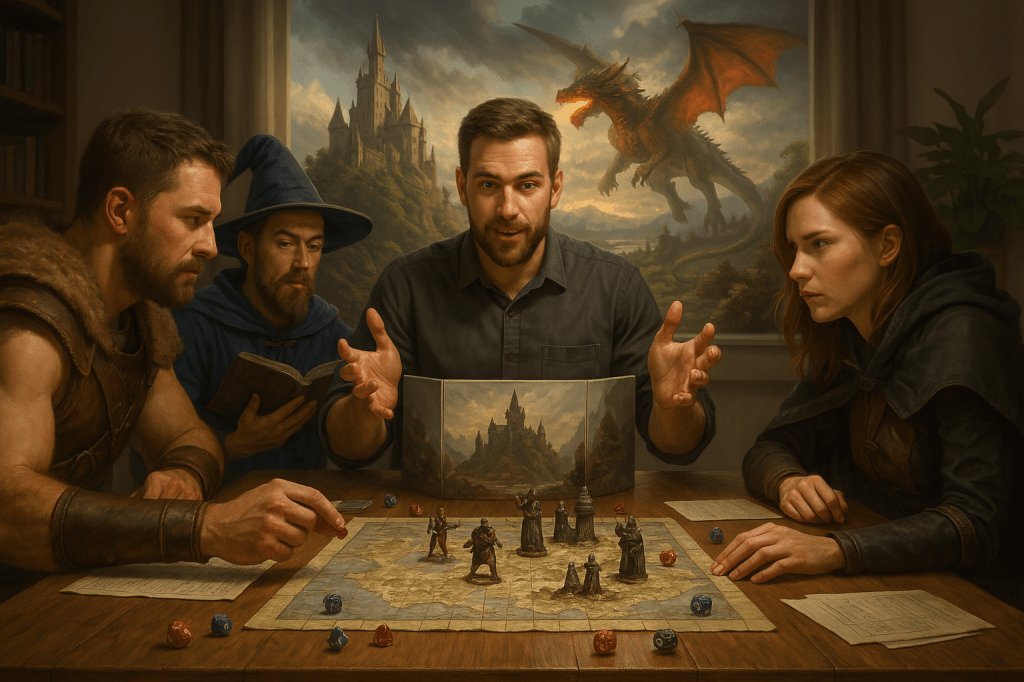
Before I ever opened Unity, before I learned a line of C#, I was slinging dice around a table with my friends—improvising stories, building worlds, and trying to outsmart a dragon without getting turned into ash.
Those late nights playing D&D didn’t just spark my love for storytelling—they quietly trained me for game dev.
If you’re an indie dev (or aspiring one), and you’ve ever run a campaign, crafted a homebrew world, or agonized over whether to give your players that OP magic item… you’re already learning some of the most important lessons in game development.
Here’s how.
🌍 1. Worldbuilding That Feels Lived In
When you’re running a D&D campaign, you’re not just creating locations—you’re crafting a world that reacts to the players. Towns have politics. Forests have forgotten ruins. NPCs have grudges, goals, and secrets.
Sound familiar?
In game dev, especially narrative or adventure-focused games, believable worldbuilding is everything. And D&D trains you to think about how and why your world works—not just what it looks like.
What to Bring Into Game Dev:
- Don’t just build cool environments—give them purpose.
- Design your world as if it could exist without the player… and then ask how it changes because of them.
🎲 2. Meaningful Choices Matter More Than Big Ones
D&D teaches you that players don’t always want to change the world—they just want the world to respond to them.
They want:
- The shopkeeper to remember they saved her kid
- That moment of silence when they choose not to kill the villain
- The weird, one-time interaction that feels tailor-made for their character
These are the kind of choices that stick with people. And they’re absolutely achievable in small indie games.
What to Bring Into Game Dev:
- Include small, flavor-rich moments that reflect the player’s actions.
- Don’t over-engineer massive choice trees—focus on making 2–3 moments feel personal.
⚔️ 3. Rules Are Tools, Not Chains
One of the coolest things about tabletop games is that you get to decide the rules. The DM makes judgment calls. House rules are born. Mechanics are tweaked to make the experience more fun or more fair.
That’s a mindset every indie dev needs.
As developers, we often feel locked into design patterns or genre norms. But if a mechanic isn’t working—or if there’s a better, weirder, more fun way to do it—change it.
What to Bring Into Game Dev:
- Build systems that support the vibe, not just the genre.
- Don’t be afraid to simplify, break, or invent rules that better serve your story.
🔀 4. Improvisation Is a Core Dev Skill
D&D DMs know this intimately: no plan survives the players.
They’ll skip the dungeon. Befriend the villain. Solve your carefully crafted puzzle with a cantrip and a goat.
Guess what? Players in your game will do the same.
They’ll break things. Miss what you think is obvious. Do things in the “wrong” order. And that’s okay.
D&D teaches you to expect the unexpected—and to see it not as failure, but as emergent gameplay.
What to Bring Into Game Dev:
- Build your systems to allow flexibility where it makes sense.
- Celebrate the “wrong” way if it still feels fun.
- Leave room for discovery, chaos, and interpretation.
🧙♂️ 5. Characters > Plot
One of the biggest lessons I learned as a DM is that players don’t remember your 2000-year-old backstory about the ancient dragon war.
They remember:
- The halfling innkeeper who always has a pie ready
- The haunted knight who gave them a blessing and vanished
- The moment their choices shaped who their character became
If you want players to care about your game, give them characters with heart—not just lore dumps and dramatic narration.
What to Bring Into Game Dev:
- Make your characters feel human (or elf, or goblin, or sentient mushroom).
- Give them wants, flaws, humor, and pain.
- Let players bond with them, not just talk to them.
🎮 Final Thoughts from Legend Games
If you’ve ever felt like your tabletop hobby was “just for fun,” think again.
Running or playing in a D&D campaign teaches some of the most important design lessons you can carry into indie game development:
- How to build immersive worlds
- How to write meaningful, reactive choices
- How to break rules that don’t serve the story
- How to build systems that inspire curiosity and creativity
At Legend Games, we’re not shy about it: our roots are deep in fantasy storytelling, roleplaying, and the chaotic beauty of tabletop games.
They’ve shaped how we design, how we think, and how we connect with our players.
So next time you’re rolling dice at the table, remember:
You’re not just playing a game—you’re training to build one.
– Legend Games

 Legend games
Leave a comment